Search This Blog

Friday, June 23, 2006

भगवान् विष्णु के दस अवतार / Ten Avtars of Lord Vishnu / Ten incarnations of Lord Vishnu / Dasavtar concept and the theory of evolution

Dasavtar concept and the theory of evolution

In the Hindu mythology the Dasavatar (10 incarnations) of Lord Vishnu,who incarnated from time to time to save mankind from the evils


The first four are said to have appeared in the Satya Yuga (the first of the fouror ages in the time cycle described within Hinduism). The next threeavatars appeared in the Treta Yuga, the eighth descent in the Dwapara Yuga and the ninth in the Kali Yuga. The tenth is predicted to appear at theend of the Kali Yuga in some 427,000 years time Yugas 

The 9 incarnations of Vishnu, which have taken place so far according to the myth, are (1) Matsya - fish, (2) Koorma - tortoise, (3) Varaha - boar, (4) Narasimha - half man-half lion, (5) Vaman - dwarf man, (6) Parashuram - man with an axe, (7) Rama - moral man, (8) Krishna - philosophical man and (9) Buddha - spiritual man. The 10th incarnation is Kalki or holocaust, which will come when evil overtakes the whole world in the milennia to come.
 The Avatar  Evolution stage
Matsya - fish Acquatic form
Koorma - tortoise Amphibian
Varaha - boar Land animals
Narasimha - half man-half lion Transition to human
Vaman - dwarf man Homo sapiens
Parashuram - man with an axe Savages
Rama - moral man Family and social life
Krishna - philosophical man Philosophy and teaching
Buddha - teacher Spiritual life

The scientific theory of evolution generated from western world states that life on earth began as single-cell organisms and later developed into multi-cell living beings. Moreover, the theory further states that aquatic creatures came into existence first. Then came amphibians that could exist in water as well as on land. Land-dependent animals and airborne birds followed the amphibians. Finally, human beings completed the cosmic drama of creation.

As if to explain this theory of evolution, Indian mythology says that first there was only primeval water which covered the earth like a flood. Vishnu's 


First incarnation as a fish (Matsya) indicated the first appearance of life in the aquatic form. It appeared in Satya Yuga.


Second incarnation as a tortoise (Koorma) represented the amphibian stage. It appeared in Satya Yuga.

                                                         
The boar (Varaha) manifestation in his third incarnation stood for the stage of animal life on land. It appeared in Satya Yuga.


The transition from animals to humans was beautifully advanced by a concept of half-man-half-lion (Narasimha) in the fourth incarnation.
It appeared in Satya Yuga.

                                                             
Vishnu’s fifth incarnation showed the further march of evolution – the appearance of early homo sapiens, symbolised by the dwarf Vamana.
It appeared in Treta Yuga.

                                                       
Then, tall but violent savages wielding weapons walked the earth. Parashuram was that violent axe-bearing sixth incarnation. It appeared in Treta Yuga.

Evolution had by now definitely entered the human stage, and the human form and mind were getting more and more refined, first in the moral sense and then in the spiritual.
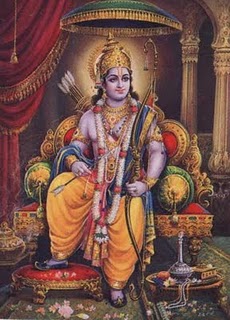


Rama, the seventh incarnation in the human form was an example of rectitude, courage and morality. It appeared in Treta Yuga.


Krishna, the eighth incarnation in the human form who originated the Bhagvad Gita, was the philosopher, the teacher of the world. It appeared in Dwapara Yuga.


Gautama, the Buddha, the ninth incarnation, was closest to nirvana,, moksha or salvation. It appeared in Kali Yuga.


And Kalki, the tenth incarnation, yet to manifest itself, would be the ultimate terminator who would finish the evolutionary process in one mighty holocaust. It will appear  in the end of Kali Yuga.
Tuesday, May 16, 2006

Meaning of God Ganesha , गणेश महिमा


शुक्लाम्बरधरं देवं शशिवर्णं चतुर्भुजम् ।
प्रसन्नवदनं ध्यायेत् सर्वविघ्नोपशान्तये ॥


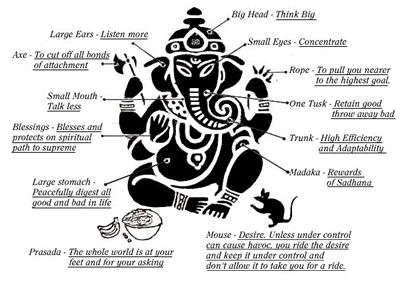
There are many puranic stories in which we have been told to pray to first, before you start anything new. and performing any auspicious work we all must start from god ganesha and this is the only god of whole world which removes of obstacles. Lord Ganesha is just not only god to pray n does not imply to perform the rituals only but his idol has lot of meaning in it and by looking at with a closer feel we will find a deeper meaning behind the Gods symbol and his symbol says lot of messages to our society.
Elephant Head - Big head which have brain and memory like elephant so it means think big and this elephant-head represents the highest form of animal
Big Ears - Listen  all and more so we should listen exhaustively to all before reaching to any conclusion
and more
Small Eyes - His eyes are not so expressive and can concentrate so it mean one should not be so expressive so that no one could understand whats going in their mind and concentrate in his work and be practical in life 
Trunk -  Ganesha's trunk symbolizes the ability to use discrimination - viveka in every action of life. The elephant uses its trunk to push down a big tree,carry heavy weights and also can pick up a small grass and pick up small needle and can break a small coconut and can  remove the hard nut and eat the soft kernel inside. so elephant’s trunk is only in the nature that can perform both gross and subtle actions  . So its the message to us that to develop our intellect, our powers of discrimination, in both the gross or material world and also in the subtle or spiritual world. 
Large Stomach - To digest all kind of food so it gives the message that we must listen to all and same time we digest it, means all the good and bad part of life we have to digest or accept it and we should not react aggressively or in bad way. So we all must be able to accept and digest whatever experiences we go through – be they good or bad. Throughout our trials and tribulations we must be equal-minded and realise that all experiences are learning experiences and will bring us closer to God.
Small Mouth - Elephant is calm animal in his own and he can shout loud only when required. so one should speak his message which should be clear and loud when needed
Axe- Axe in his hand means to cut off all bond of the attachment when needed and live spiritually.
Rope- Rope in his hand means to pull us nearer highest to god and pull us to deeper in that work we are doing for the nature and our duty and never let us run away from our duties of good living life
Modakam (Sweets) - Sweet or Laddo or Modakam is the the reward of the sweetness of knowledge which give us joy, satisfaction and contentment after traveling on the path of enlightenment. It is also the indication of eating the correct Sathwic food so that we only speak sweet words.The importance of the elephant is also that it is a herbivore, eating Sathwic food – a calm and gentle animal that also has immense strength, which it uses only when needed.
Lord Ganesha sits with one leg folded up and the other leg resting on the ground. The leg on the ground tells us that we can live in the world like anyone else. But the leg pointing upwards tells us that our concentration and meditation should be ever focussed on the god.
Holly Flower The Lotus - He holds in his hand and lotus grows in stagnant water, but the flower on the top  above the water line so that their purity will not be blemished by the polluted waters underneath . So it means we should live in this world but remain unpolluted by the materialism and negative qualities of our surroundings
At the feet of Lord Ganesha spreads a huge array of different kinds of food thats the Prasadam (the Holy food from god) The food represents material wealth, power and prosperity and indicates that if you do live a life of high ideals & principals, these material benefits will always be available for you, although you will not be attached to them and they will therefore not hinder your spiritual progress. Thats why prasadam is distributed to all in small quantity.
The Vehicle is little rat or mooshikham- Rat represents desire. Rats by nature  are very greedy creatures who will run here and there nibbling and hoarding far more than they need. If a man has desires, he can waste his whole life running here and there, fulfilling one desire, only to replace it with another.So the message of this to the society is that one should be like Lord Ganesha and keep our desires undercontrol, never allowing them to overwhelm us. So we must ride on our desire and never let the desire ride on us

Friday, April 7, 2006

Rahu Kaal , Rahu Kalam , राहु काल , राहु कालम्

RAHU KAAL (Bad Time)
According to Hindu Astrology certain parts of the day between Sunrise and Sunset about one and half hours are inauspicious periods and one should not do any auspicious work during these periods - especially any new work and this is RAHU KAAL (BAD TIME) or  Rahu Kalam, Rahu kaal differs from place to place depending on Sun-rise & Sun-set time at a particular location that is place and country

Any auspicious new work is not to start during this time. It will not give a good result. So one should not start any new Journey, Work, Job, Interview, marriage, business dealing, Sale or purchase of any assets , Foundation of home ,plant and building , Digging well and many other auspicious work . They are prohibited during this time. But it will not affect in work , journey or trade already in progress .
For any good mahurat or auspicious time ,after selecting good and auspicious Thithi, Vara, Nakshtra, Yoga and Karana, the selection of a particular moment that is Rahu kaal should be avoided
According Hindu Astrology, there are seven days in a week ie. from Sunday to Saturday and each day is being ruled by a particular planet and has its own ruling deity. As per our ancient and classical texts says that ruler of the day is prescribed that is as under:
  • Sunday is ruled by Ravi ( Sun)
  • Monday is ruled by Chandra ( Moon)
  • Tuesday is ruled by Kuja ( Mars)
  • Wednesday is ruled by Budha ( Mercury)
  • Thursday is ruled by Guru (Jupiter)
  • Friday is ruled by Sukra (Venus)
  • Saturday is ruled by Shani (Saturn)
Our holy rishies have given equal importance to Rahu and Ketu. However, they did not give any specific day for them as they treated Rahu and Ketu as nodes. However, Rahu and Ketu will be given one and half hours time in a day.

Rahu Kaal as on sunsrise at 6:00 AM Delhi and as per Vishvavijaya Panchang is –

Day               Time  

Sunday        4.30 PM to 6.00 PM

Monday         7.30 AM to 9.00 AM

Tuesday        3.00 PM to 4.30 PM

Wednesday   12.00 PM to 1.30 PM

Thursday       1.30 PM to 3.00 PM

Friday            10.30 AM to 12.00 PM

Saturday       9.00 AM to 10.30 AM


Easy way to remember rahu kalam

Just remeber this phrase

"Mother Saw Father Wearing The Turban on Sunday"

Mo-ther    -   7:30    AM - 9:00 AM     -    MONDAY
Sa-w        -   9:00    AM - 10:30 AM   -    SATURDAY
F-ather     -   10:30 AM - 12:00 PM   -    FRIDAY
W-earing  -   12:00 PM - 1:30 PM     -     WEDNESDAY
Th-e         -   1:30    PM - 3:00 PM    -      THURSDAY
Tu-rban    -   3:00    PM - 4:30 PM    -      TUESDAY
Sunday    -    4:30    PM - 6:00APM   -    SUNDAY

Note – For accurate and correct Rahu Kaal time of any location of the world please contact on my email below this site

Sunday, March 5, 2006

स्वस्ति-वाचन

स्वस्ति-वाचन
नो भद्राः क्रतवो यन्तु विश्वतोऽदब्धासो अपरीतास उद्भिदः
देवा नो यथा सदमिद् वृधे असन्नप्रायुवो रक्षितारो दिवे-दिवे

देवानां भद्रा सुमतिर्ऋजूयतां देवानां रातिरभि नो नि वर्तताम्
देवानां सख्यमुप सेदिमा वयं देवा आयुः प्र तिरन्तु जीवसे
 
तान् पूर्वया निविदा हूमहे वयं भगं मित्रमदितिं दक्षमस्रिधम्
अर्यमणं वरुणं सोममश्विना सरस्वती नः सुभगा मयस्करत्

तन्नो वातो मयोभु वातु भेषजं तन्माता पृथिवी तत् पिता द्यौः
तद् ग्रावाणः सोमसुतो मयोभुवस्तदश्विना शृणुतं धिष्ण्या युवम्

तमीशानं जगतस्तस्थुषस्पतिं धियंजिन्वमवसे हूमहे वयम्
पूषा नो यथा वेदसामसद् वृधे रक्षिता पायुरदब्धः स्वस्तये

स्वस्ति इन्द्रो वृद्धश्रवाः स्वस्ति नः पुषा विश्ववेदाः
स्वस्ति नस्तार्क्ष्यो अरिष्टनेमिः स्वस्ति नो बृहस्पतिर्दधातु

पृषदश्वा मरुतः पृश्निमातरः शुभंयावानो विदथेषु जग्मयः
अग्निजिह्वा मनवः सूरचक्षसो विश्वे नो देवा अवसा गमन्निह

भद्रं कर्णेभिः शृणुयाम देवा भद्रं पश्येमाक्षभिर्यजत्राः
स्थिरैरङ्गैस्तुष्टुवांसस्तनूभिर्व्यशेम देवहितं यदायुः

शतमिन्नु शरदो अन्ति देवा यत्रा नश्चक्रा जरसं तनूनाम
पुत्रासो यत्र पितरो भवन्ति मा नो मध्या रीरिषतायुर्गन्तोः

अदितिर्द्यौरदितिरन्तरिक्षमदितिर्माता पिता पुत्रः
विश्वे देवा अदितिः पञ्च जना अदितिर्जातमदितिर्जनित्वम
(ऋक॰१।८९।१-१०)

कल्याणकारक, दबनेवाले, पराभूत होने वाले, उच्चता को पहुँचानेवाले शुभकर्म चारों ओर से हमारे पास आयें। प्रगति को रोकने वाले, प्रतिदिन सुरक्षा करने वाले देव हमारा सदा संवर्धन करने वाले हों। सरल मार्ग से जाने वाले देवों की कल्याणकारक सुबुद्धि तथा देवों की उदारता हमें प्राप्त होती रहे। हम देवों की मित्रता प्राप्त करें, देव हमें दीर्घ आयु हमारे दीर्घ जीवन के लिये दें। उन देवों को प्राचीन मन्त्रों से हम बुलाते हैं। भग, मित्र, अदिति, दक्ष, विश्वास योग्य मरुतों के गण, अर्यमा, वरुण, सोम, अश्विनीकुमार, भाग्य युक्त सरस्वती हमें सुख दें। वायु उस सुखदायी औषध को हमारे पास बहायें। माता भूमि तथा पिता द्युलोक उस औषध को हमें दें। सोमरस निकालने वाले सुखकारी पत्थर वह औषध हमें दें। हे बुद्धिमान् अश्विदेवो तुम वह हमारा भाषण सुनो। स्थावर और जंगम के अधिपति बुद्धि को प्रेरणा देने वाले उस ईश्वर को हम अपनी सुरक्षा के लिये बुलाते हैं। इससे वह पोषणकर्ता देव हमारे ऐश्वर्य की समृद्धि करने वाला तथा सुरक्षा करने वाला हो, वह अपराजित देव हमारा कल्याण करे और संरक्षक हो। बहुत यशस्वी इन्द्र हमारा कल्याण करे, सर्वज्ञ पूषा हमारा कल्याण करे। जिसका रथचक्र अप्रतिहत चलता है, वह तार्क्ष्य हमारा कल्याण करे, बृहस्पति हमारा कल्याण करे। धब्बों वाले घोड़ों से युक्त, भूमि को माता मानने वाले, शुभ कर्म करने के लिये जाने वाले, युद्धों में पहुँचने वाले, अग्नि के समान तेजस्वी जिह्वावाले, मननशील, सूर्य के समान तेजस्वी मरुत् रुपी सब देव हमारे यहाँ अपनी सुरक्षा की शक्ति के साथ आयें। हे देवो कानों से हम कल्याणकारक भाषण सुनें। हे यज्ञ के योग्य देवों आँखों से हम कल्याणकारक वस्तु देखें। स्थिर सुदृढ़ अवयवों से युक्त शरीरों से हम तुम्हारी स्तुति करते हुए, जितनी हमारी आयु है, वहाँ तक हम देवों का हित ही करें। हे देवो सौ वर्ष तक ही हमारे आयुष्य की मर्यादा है, उसमें भी हमारे शरीरों का बुढ़ापा तुमने किया है तथा आज जो पुत्र हैं, वे ही आगे पिता होनेवाले हैं, सब देव, पञ्चजन (ब्राह्मण, क्षत्रिय, वैश्य, शूद्र और निषाद), जो बन चुका है और जो बनने वाला है, वह सब अदिति ही है। (अर्थात् यही शाश्चत सत्य है, जिसके तत्त्वदर्शन से परम कल्याण होता है)

Saturday, February 4, 2006

Planets & Colors & Jewels

i m working on it
sorry for that

Sunday, January 1, 2006

नवग्रहस्तोत्रम्

नवग्रहस्तोत्रम्
Navagraha Stotram by Vyas


जपाकुसुमसंकाशं काश्र्यपेयं महाद्युतिम्
तमोरिं सर्वपापघ्नं प्रणतोsस्ति दिवाकरम् ॥१॥

I pay homage to the Sun, the bright shining One, the maker of the day, enemy of darkness, destroyer of evils, resembling a Chinese rose, descendent of Kashyapa. [1]

दधिशङ्कतुषाराभं क्षीरोदार्णवसम्भवम्
नमामि शशिनं सोमं शम्भोर्मुकुटभूषणम् ॥२॥

I pay homage to the Moon, Soma, who serves as an ornament on Shiva’s crown, who was born from the ocean of milk and whose color is that of curd, conch, or snow. [2]

धरणीगर्भसंभूतं विद्युत्कान्तिसमप्रभम्
कुमारं शक्तिहस्तं तं मङ्गलं प्रणमाम्यहम् ॥३॥
 

I pay homage to Mangala, the handsome youth with weapon in hand, born from mother earth, whose luster resembles the lightning in the sky. [3]

प्रियङ्गुकुलिकाश्र्यामं रूपेणाप्रतिमं बुधम्
सौम्यं सौम्यगुणोपेतं तं बुधं प्रणमाम्यहम् ॥४॥
 

I pay homage to Budha, son of the Moon, resembling the dark green bud of the priyangu flower, unrivaled in beauty, of calm and collected disposition. [4]

देवानां ऋषीणां गुरूं काञ्चनसंनिभम्
बुद्धिभूतं त्रिलोकेशं तं नमामि बृहस्पतिम् ॥५॥
 

I pay homage to Brhaspati, the guru of gods and rishis, who shines with golden luster, the embodiment of cosmic intelligence, the guiding light of the three worlds. [5]

हिमकुन्दमृणालाभं दैत्यानां परमं गुरुम
सर्वशास्त्रप्रवक्तरं भार्गवं प्रणमाम्यहम् ॥६॥
 

I pay homage to Shukra, descendant of Bhrigu, the supreme guru of the demons, the greatest expounder of all shastras, whose complexion resembles the white lotus, the jasmine flower, or snow. [6]

निलाञ्जनसमाभासं रविपुत्रं यमाग्रजम्
छायामार्तणडसम्भूतं तं नमामि शनैश्र्वरम् ॥७॥
 

I pay homage to Shani, the slowmoving, son of the Sun, born from Chaya and Martanda, Yama’s elder brother, who is of dark complexion like the blue eye ointment. [7]

अर्धकायं महावीर्यं चन्द्रादित्यविमर्दनम्
सिंहिकागर्भसम्भूतं तं राहुं प्रणमाम्यहम् ॥८॥
 

I pay homage to Rahu, the half-bodied one, offspring of Simhika, possessing great strength, the sworn enemy of the Sun and Moon. [8]

पलाशपुष्पसंकाशं तारकाग्रहमस्तकम्
रौद्रं रौद्रात्मकं घोरं तं केतुं प्रणमाम्यहम् ॥९॥
 

I pay homage to Ketu, one of the eleven Rudras, chief among planets and stars, resembling the palasha flower, and of dreadful appearance. [9]

इति व्यासमुखोद् गीतं : पठेत् सुसमाहित:
दिवा वा यदि वा रात्रौ विघ्नशान्तिर्भविष्यति ॥१०॥
 

Thus ends the hymn of praise to the nine planets, born from Vyasa’s mouth as assembled by him. For one who chants this hymn, whether by day or night, all obstructions will melt away. [10]

नानारीनृपाणां भवेद्दु:स्वप्ननाशनम्
ऐश्वर्यमतुलं तेषामारोग्यं पुष्टिवर्धनम् ॥११॥
 

Whether for men, women, or kings, it brings them destruction of evil, unrivaled sovereignty, freedom from disease, and growth of strength. [11]

ग्रहनक्षत्रजा: पीडास्तस्कराग्नसमुद्भवा:
ता: सर्वा: प्रशमं यान्ति व्यासो ब्रूते संशय: ॥१२॥
 

All afflictions born of the planets, stars, thieves, or fire will be removed. Vyasa tells us that there is no doubt about this. [12]

इति व्यासविरचितं नवग्रहस्तोत्रं सम्पूर्णम्